
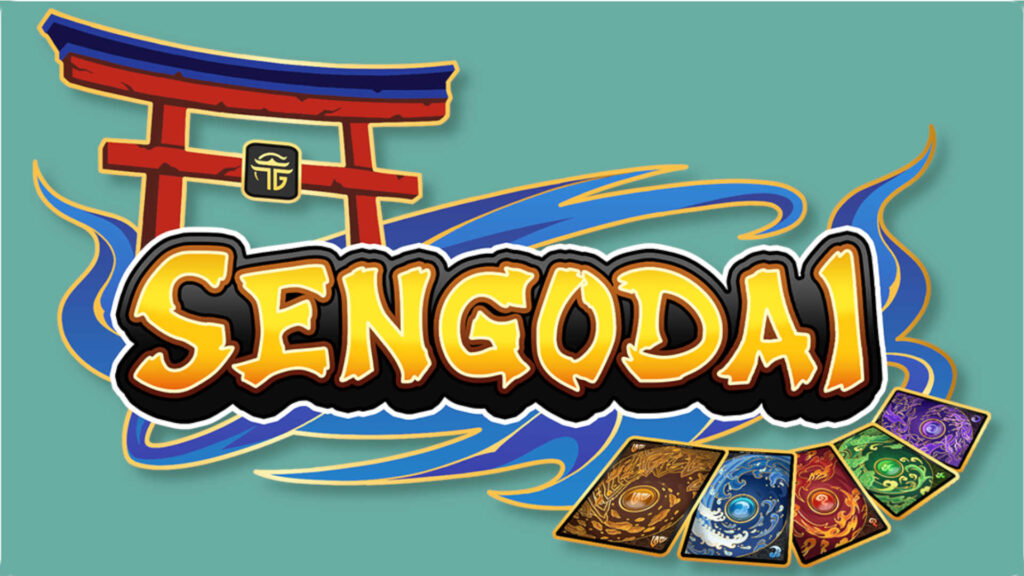
Another week, another roguelike deckbuilder to add to the vast array of games in the genre on Steam. Yet Sengodai does enough to stand out from the crowd to be of interest to card game fans. Let’s take a look at this intriguing new title, in our Sengodai review!
What is Sengodai?
In Sengodai, you have an Elemental God as a sort of leader or commander card, along with a team of three Gokai, which you’ll use to purify land cards in the center of the battlefield. Aside from the very beginning of a battle, where you start with just one land card (then two), there will be three land cards in play, each with their own elemental symbols. You’ll charge your Gokai with colored elements from your hand, and in turn they can then purify lands with matching colored symbols.

Purifying one or more symbols on a land card will earn you power that your Elemental God can use with one of their abilities, and if you manage to purify all three symbols on a land card, you’ll do a point of damage to the opposing God’s health. Reduce the opponent to zero health, and you win. Of course, they’re doing the same thing to you, so you have to balance charging your Gokai with purifying, given that they have stamina which could render them unusable for a few turns, in a way that doesn’t leave you too open to attacks from your opponent.
Between rounds, you’ll make your way through a path of encounters that’ll be instantly familiar to roguelike fans, with combat, treasure chests and shops, along with random events, to deal with as you progress.
Is Sengodai Fun to Play?

There’s no denying that Sengodai is a gorgeous, vibrantly colorful game. Its Japanese folklore theming is really nice, and the Gokai, as well as the Elemental Gods, are appealingly well designed. The color and symbol-based gameplay is instantly accessible, and Sengodai is a really easy game to pick up and play.
Yet that last part is also a bit of a problem; though Sengodai looks great, its gameplay loop is far too simplistic and reliant on luck. It lacks the depth and strategic layers that roguelike deckbuilding fans are used to, and though its core gameplay can be pretty compelling, it also becomes pretty repetitive, rather quickly. It also seems unfair to have a deck filled with cards in colors you can’t even use if your Gokai don’t have the same symbol, without much of a chance to remove them.

Additionally, there’s a pretty small number of cards to collect, so it won’t be long before you feel as if you’ve seen a lot of what the game has to offer; encounters aren’t all that varied or distinct either, and there are far too opportunities to actually engage in proper deckbuilding, or to spend the coins you’ll earn as you play. You’ll also rarely be challenged too much, even by opponents who have much higher health than you; I have been absolutely breezing through the game’s worlds without breaking a sweat at all.
Despite distinctive visual design, given that Gokai are distinguishable mechanically only by the elements they can generate, there’s no real feeling of desire to collect them all, and Elemental Gods also suffer from uninspiring abilities that are rarely used to great effect during encounters.
It’s a shame, because when Sengodai works, it’s a pretty laidback experience, and there is a certain hypnotic charm to its gameplay, for a time at least. Despite encountering a few bugs here and there, the base gameplay is solid, but it just feels like it needs a little more in terms of strategy and depth, and less reliance on the luck of the draw when it comes to lands or the cards in your hand.
The Card Gamer Verdict
A deckbuilding game with immediately appealing audiovisual design and a theme based around supernatural Japanese creatures purifying cursed lands, Sengodai is incredibly accessible and nicely produced. It has a gorgeous soundtrack, perfectly complementing the vibrant visuals and Japanese theme.
However, the simple gameplay’s immediacy doesn’t ever feel like it ramps up to a satisfying enough level of complexity, and the fact is that Sengodai feels pretty shallow after a very short time with it. That said, Sengodai is certainly far from a bad game, and works as a beginner’s roguelike deckbuilding game, or a title which younger players might enjoy. If you’re an experienced deckbuilding game fan, however, it’s not likely to capture your attention for very long.
Sengodai is available now on Steam and mobile, for Android devices. Releases on further formats are planned, but as yet no dates are confirmed.
Check out our reviews of other roguelike deckbuilding games featuring lots of supernatural creatures, such as Monster Train 2 and Decktamer.