
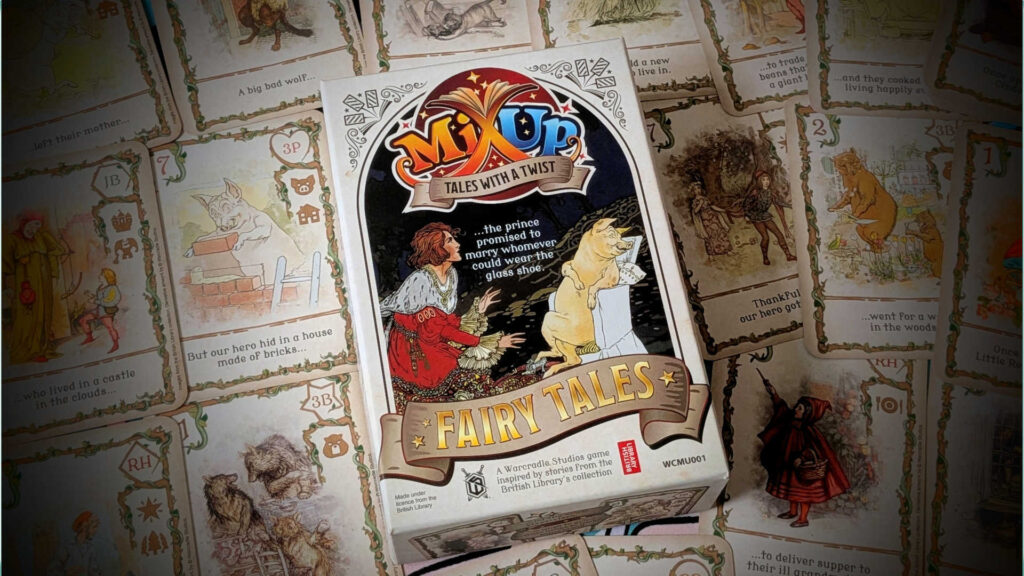
Wouldn’t it be fun to take several classic, iconic fairy tales and put them in a blender, mixing them up to make entirely new, and very silly, stories for children? You can do just that in Mix Up Fairy Tales, a new title from Warcradle Studios with art licensed from the British Library’s collection. Let’s check out Mix Up Fairy Tales!
Getting Started With Mix Up Fairy Tales
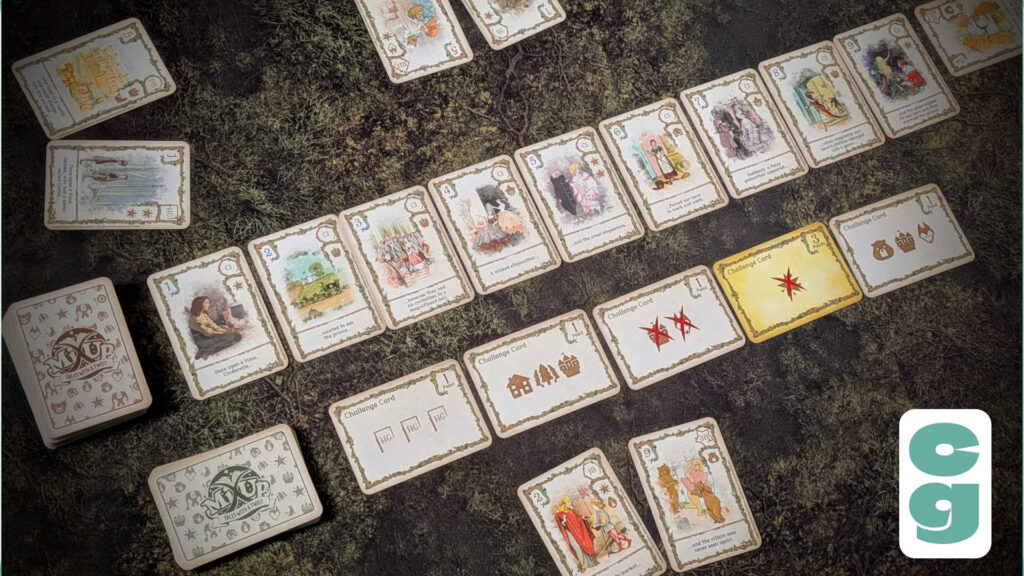
Players decide on a starting story from the double sided starting card deck (either Aladdin or Cinderella). Then, you’ll lay the chosen story cards out in order from 1-9 in a row in the middle of the table. This is the Fairy Tale. The story card deck is shuffled, and two cards are dealt to each player, face up. The remaining cards are placed on the table in reach of all players as the story deck. Five challenge cards are dealt next to the story row, and the rest of the challenge cards are placed next to this row, face down, as the challenge deck. The first player is whoever most recently read a fairy tale; play then goes clockwise from them.
Taking Your Turn in Mix Up Fairy Tales
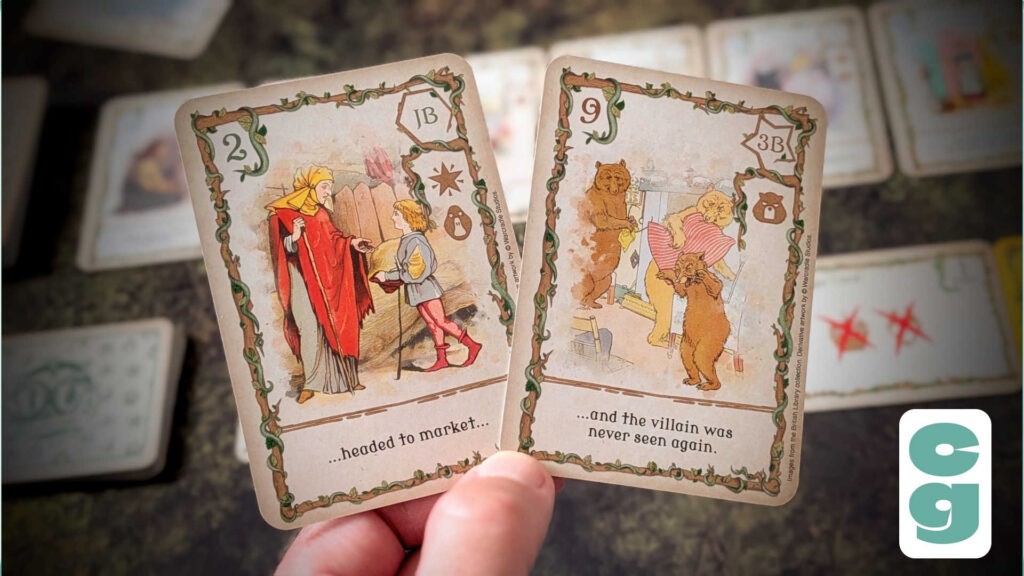
Each turn has six steps:
- Draw 2 cards to your face up hand from the story deck.
- Play 2 cards from your hand into the current Fairy Tale.
- Read out the Fairy Tale from card number 1 to card number 9.
- You can then score challenge cards: if the Fairy Tale contains all of the Plot symbols shown, and none of the Forbidden Plot symbols, you can score that card. You can score multiple cards in this way by placing them in a score pile, leaving the spaces in the challenge row empty for now.
- You may discard up to 2 of the remaining, unscored challenge cards. These go to a discard pile.
- Finally, draw challenge cards from the challenge deck to replace the scored cards; there should now be 5 challenge cards again, and the next player begins their turn from step 1.
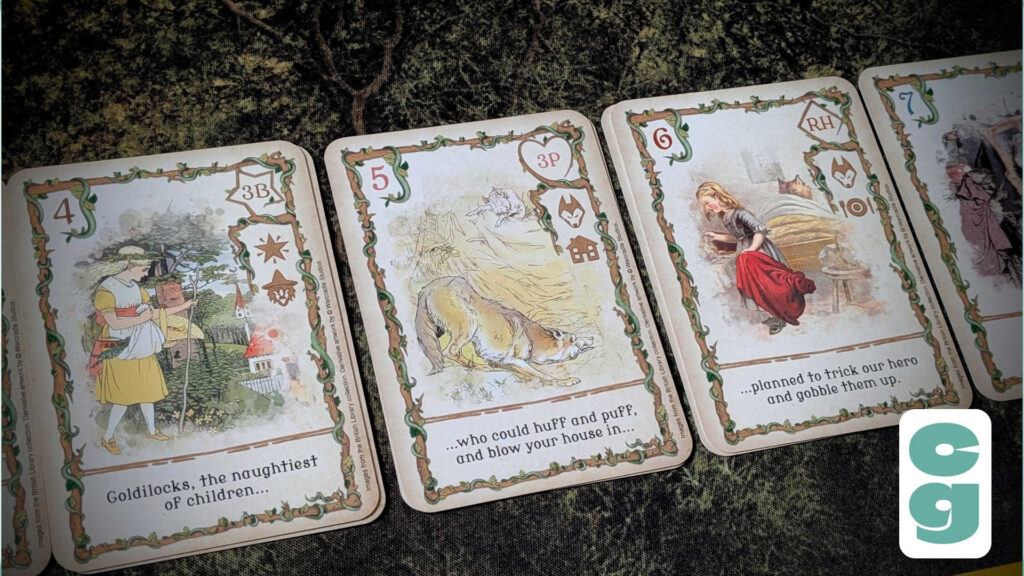
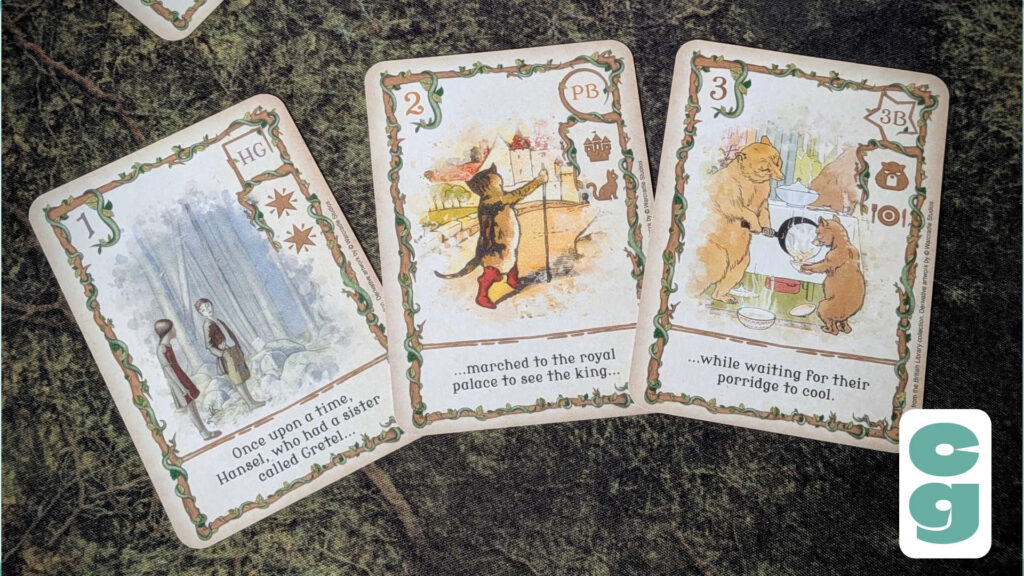
When a story card is placed in the Fairy Tale, it must be placed in the correct numbered space in the Fairy Tale row, on top of the current card bearing the same number. The sequence number is shown on the top left of the card, as you can see from the closeup of the Fairy Tale above. This image shows cards 4, 5 and 6 in the Fairy Tale.
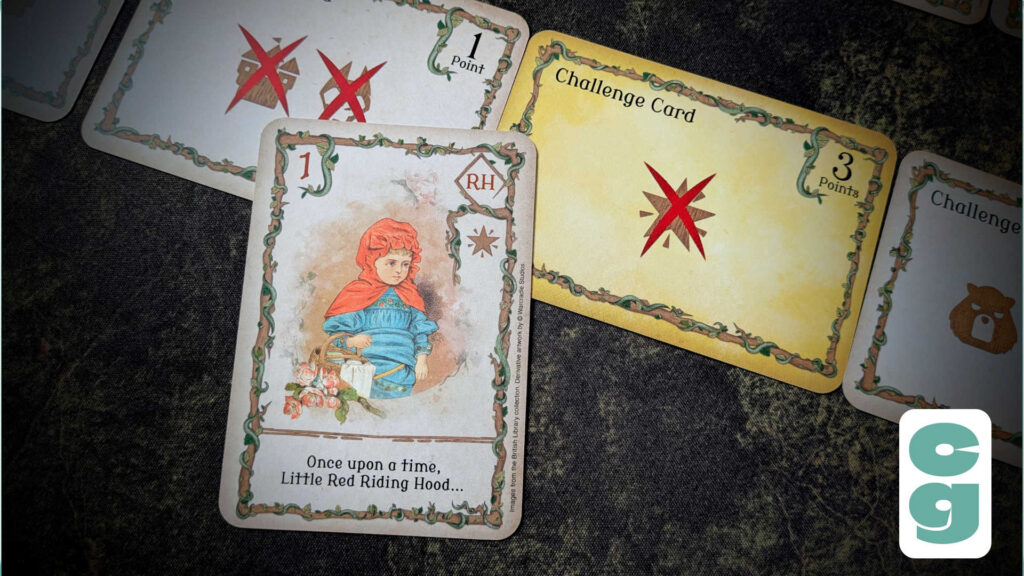
The story the card is from is noted in abbreviated form on the top right, and this also doubles as a plot symbol for challenge card scoring. Other plot symbols are below this, on the right of the card, and again are used to score challenge cards. So for example, the 1 card shown above is from Red Riding Hood (abbreviated to RH on the top right). The plot symbol shows a star; if this card is placed in the Fairy Tale, it won’t be able to score the challenge card shown above to its right. That’s because the challenge card has the star as a Forbidden Plot symbol, which must not be present on any card in the current Fairy Tale if you want those 3 points!
How to Win at Mix Up Fairy Tales
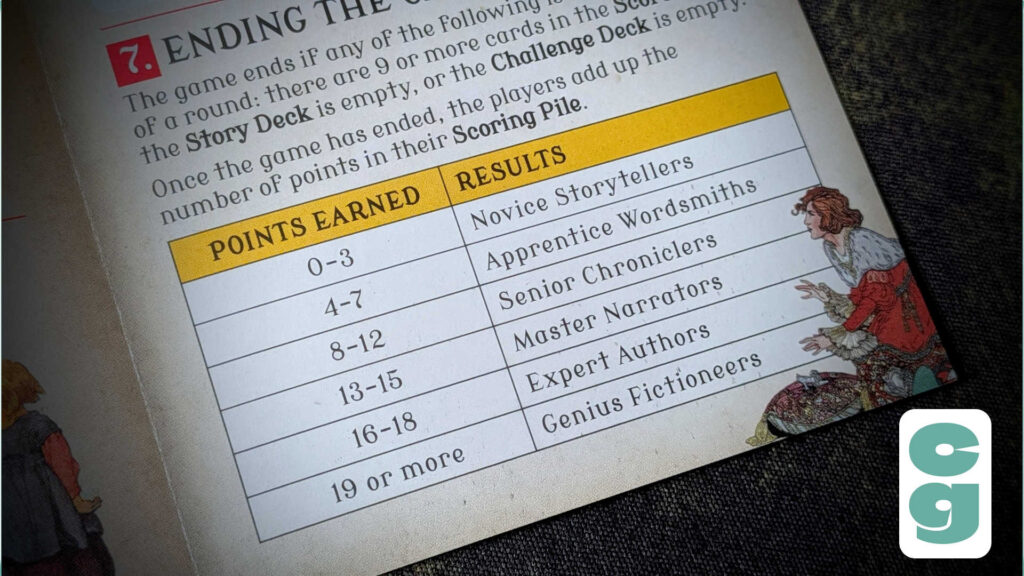
Here’s the thing: as it’s a co-operative game with an emphasis on telling silly stories, there’s no individual winner in Mix Up Fairy Tales. Instead, players aim to get the highest score by completing and collecting challenge cards together. Of course, if you really wanted to play competitively, you could easily just add challenge cards to your own score pile, and declare the winner to be the person with the most points on their collected challenge cards. However, the co-operative nature of the game makes it a kinder, more collaborative experience for everyone.
The game ends if players have collected 9 or more challenge cards in the score pile, or if either the story deck or challenge deck are empty. Players are aiming to score 19 or more points for the rank of Genius Fictioneers. That said, it doesn’t really matter how well you do; just that you have fun while playing and making silly stories together!
Is Mix Up Fairy Tales Fun to Play?
A great family game which can result in lots of laughter around the table, Mix Up Fairy Tales is a roaring, often hilariously raucous success. Though its primary audience, and the players who will likely get the most from it, are younger children and their parents, the challenge card scoring mechanic can lead to some surprisingly strategic decisions, as the swapping out of a few cards in the Fairy Tale can lead to a cascade of points when timed well.
Reading out the new Fairy Tale each turn encourages players to read what they’re creating as they go, and is the result of a lot of fun around the table, especially as the rules make it clear that this should be done in your “best storyteller’s voice”! Games move quickly too, avoiding any potential issues of the youngest participants getting bored.
The classic, old-school artwork is lovely, and the oversized cards are great quality too. It’s a very thoughtfully produced game; Mix Up Fairy Tales is a massive step above the usually very basic, lazily designed games you’d normally find in a museum or library gift shop.
The Card Gamer Verdict
A fantastic game for younger players and their parents to play together, Mix Up Fairy Tales is a great collaborative experience.
With a simple central gameplay mechanic, which can promote discussions among players each turn, and an emphasis on telling silly stories while scoring points together, Mix Up Fairy Tales is a hugely enjoyable experience for the target audience.
Older players alone won’t necessarily get the same level of enjoyment from the game, however, and its small selection of cards may prove to feel a bit limiting for all but the youngest of players. That said, the Mix Up Fairy Tales concept has a lot of potential for more sets, with countless storybooks at the British Library that could provide rich material for further expansions, either standalone or as new core boxes.
Mix Up Fairy Tales is available now from the British Library and other retailers.
Check out other family games we’ve covered, such as Super Meow and Fire in the Hole!