

The Pokémon Trading Card Game (or TCG, for short) is a game which has been available since the late 90s, and even though it’s seen several evolutions in that time, the core gameplay remains the same as it was back at the very beginning. This is generally the case with just about any TCG (sometimes known as Collectible Card Games, or CCGs) you’ll find available in stores; though they may have been around for a long time, if you played one several decades ago, you should have a grasp of what to expect if you go back to them even now. With that in mind, in this article, we’re going to take a look at where Pokémon came from, and what you can expect when you begin your journey with the Pokémon TCG. Feel free to skip ahead to the section you need; we won’t judge!
What Is the Pokémon TCG?
First things first, despite its prevalence in popular culture, it may be that Pokémon is something that has never truly caught your attention. Perhaps you’re here because you’re the parent of a child who’s just becoming interested in Pokémon, or you have friends who want you to play the game with them. So let’s go back to the beginning, and find out just where Pokémon kickstarted one of the biggest, and longest lasting pop culture phenomena of all time.
Pokémon’s Video Game Origins

Japanese video game publisher and developer, Nintendo, had been massively successful with home consoles such as the Nintendo Entertainment System (or NES), Super Nintendo Entertainment System (also abbreviated to SNES) and the handheld Game Boy throughout the 80s and early 90s. Given that the humble, monochrome Game Boy had been around since 1989, by the mid-90s and the emergence of even more powerful, CD-based consoles for home use, it was beginning to feel even more antiquated than it already was.
Despite this, the green-screened handheld still had a massive userbase, and its relative inexpensiveness (both to produce and to consumers) and superb software library meant that it still continued to be hugely popular, well beyond what would be considered the normal lifespan of a more traditional console. The seemingly endless popularity of the Game Boy meant that Nintendo would very conservatively update the machine for many years, with incremental hardware improvements, seen on revisions such as the Game Boy Pocket and Game Boy Light extending the lifespan of the console even further.
The Game Boy Pocket was introduced, with a far clearer screen that eliminated the blurring seen on the original Game Boy, not to mention the display being in shades of gray rather than green, at the same time that Pokémon, one of Nintendo’s most ambitious titles, was launched. Pokémon had already been a big hit in Japan, where it was known as ‘Pocket Monsters‘; the word Pokémon itself being a pseudo-portmanteau of the game’s original Japanese title.

Pokémon was released in the US as a simultaneous launch of two different editions in 1996. Each had their own box color and a different creature featured on the box art; the editions were Pokémon Red and Pokémon Blue. The goal of Pokémon, which is a creature collecting role-playing game (or RPG), is to fill your in-game creature collection, known as the Pokédex, by battling and capturing the different creatures you encounter across the game’s surprisingly large world. ‘Gotta catch ’em all!’ is the famous tagline of the series, which sums it up very succinctly.
Though there are 151 creatures to collect in total in those first games (a number which has now grown to well beyond 1000 Pokémon), it’s not possible to get them all with just one edition of the game. Both Red and Blue feature variations of creatures which don’t appear in the other edition, and there are times where your choices, such as which Pokémon to choose from the three starter options, closes off the other Pokémon to you entirely over the course of your game. As such, trading (and battling!) with friends has always been at the heart of the Pokémon series, as fans strive to fill their individual Pokédex with as many creatures as they can.

Those first games were an absolute phenomenon, kickstarting sales of Game Boy hardware once more, and capturing the attention of millions of kids (and adults too!) across the world. Though it has ebbed and flowed in terms of its overall popularity, Pokémon remains a popular video game series to this day, finding its current home on handheld/home console hybrid, the Nintendo Switch. Of course, you’re here reading this on Card Gamer, so you already know that Pokémon’s success has stretched far beyond its video game roots; several animated shows (and series of movies, even including a live action US blockbuster, Pokémon: Detective Pikachu), toys, assorted merchandise and of course, the TCG itself have all proven to be popular with fans who may not have even played the digital games!
When Did Pokémon Become a Card Game?
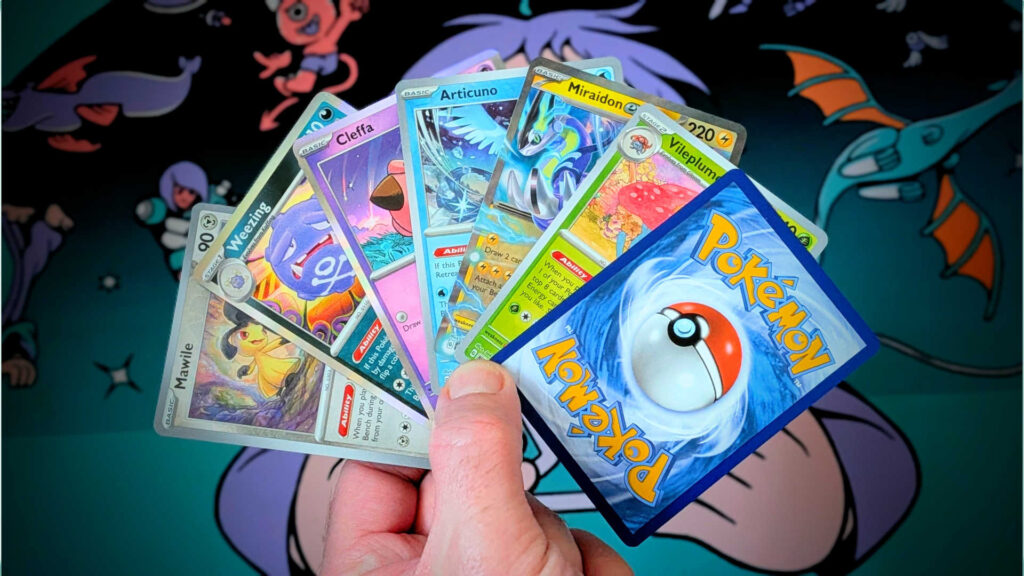
Having become a massive hit in the digital realm, Pokémon made the short leap to the tabletop in Japan in 1996. The Pokémon TCG was then translated and released in the West by Wizards of the Coast in 1998.
Wizards of the Coast had brought the very first CCG, Magic: The Gathering, into the world in 1993, and Pokémon proved to be another huge hit for the publisher. The gameplay of the Pokémon TCG sees players using their Pokémon to battle each other, with the ultimate aim being to knock out enough opposing Pokémon to earn 6 Prize Cards and win.
The TCG perfectly adapts the core elements of the video games, including trading and building a strong part of Pokémon to use in battling, to the tabletop in a clever and compelling way. After more than two decades, it’s arguably as strong as ever now, with current publishers, The Pokémon Company, struggling to keep up with demand for new sets.
Getting Started with the Pokémon TCG
The best way to get started with the Pokémon TCG is to attend a local Pokémon League, as the organizers will be more than happy to help you learn how to play the game; you can find your local League using the official locator. However, we here at Card Gamer understand that this isn’t always feasible, given that there won’t always be a Pokémon League which is local or accessible enough for all players.
In which case, we’d highly recommend starting your Pokémon journey with a Battle Academy set, which is a fully featured product that helps two players learn and play the Pokémon TCG.
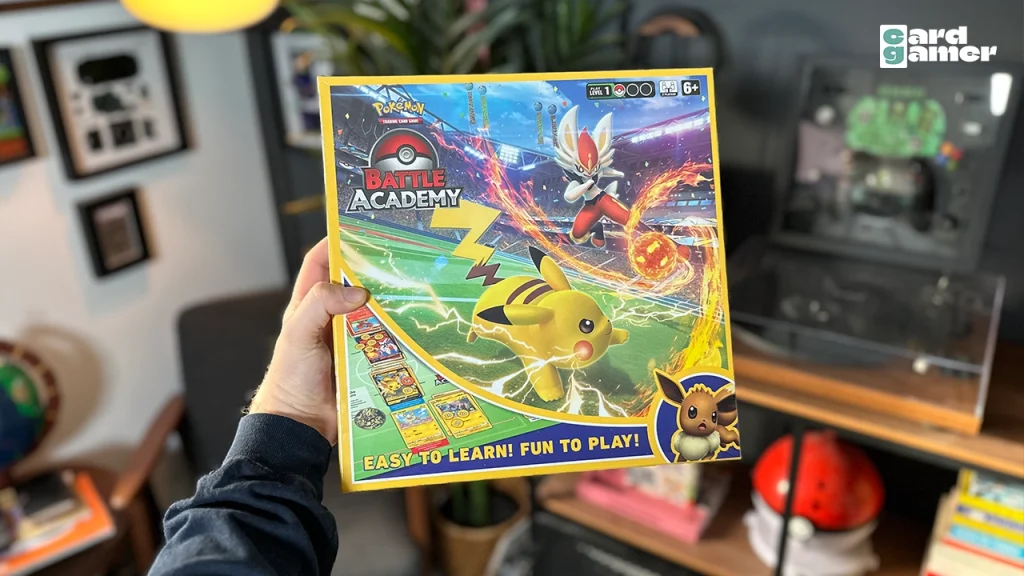
Three decks are included in the Battle Academy set, and they’re fully compatible with any other cards you acquire as you buy more Pokémon packs. It’s by far the most accessible and complete learning tool for all ages, and we’d highly recommend it over the My First Battle decks, which are aimed at extremely young players, and don’t do a great job of teaching all of the intricacies of the game. It’s also worth noting that the My First Battle cards are not compatible with any other Pokémon cards, as they have a different card back than usual. Check out our guide to Pokémon card backs for further information.
What You’ll Need to Play the Pokémon TCG
In Pokémon TCG, players use a 60 card deck, which can be pre-constructed (Pokémon Battle Decks are available, which give players a functioning deck to use without any hassle) or built by the player from their card collection. Of course, the aforementioned Battle Academy has three different 60 card decks included, so once more we’d recommend this as a great starting point.
Pokémon TCG Card Types
There are three main types of card in the Pokémon TCG: Pokémon cards, Trainer cards and Energy cards. Let’s take a look at each of these in turn.
Pokémon Cards

Pokémon themselves are most commonly found as Basic, Stage 1 and Stage 2 cards, as shown above. The image of the three cards above shows a full evolution line, with Applin being the Basic, Dipplin the Stage 1, and Hydrapple ex the Stage 2 Pokémon. We’ll take a closer look at the anatomy of Pokémon cards in the next section of this guide.
Energy Cards
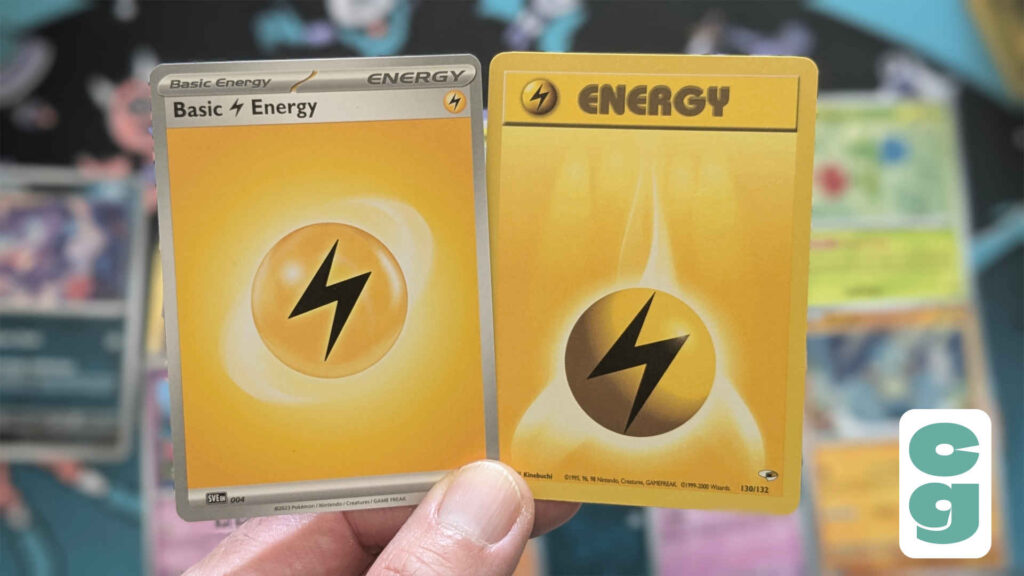
Though Basic Energy cards have changed in design somewhat over the years, they always do the same thing and any Basic Energy card, from any era, can be used in the Pokémon TCG. Note that some Energy types are no longer found in the game, such as Fairy Energy (check out our guide to Pokémon Energy types for more information).
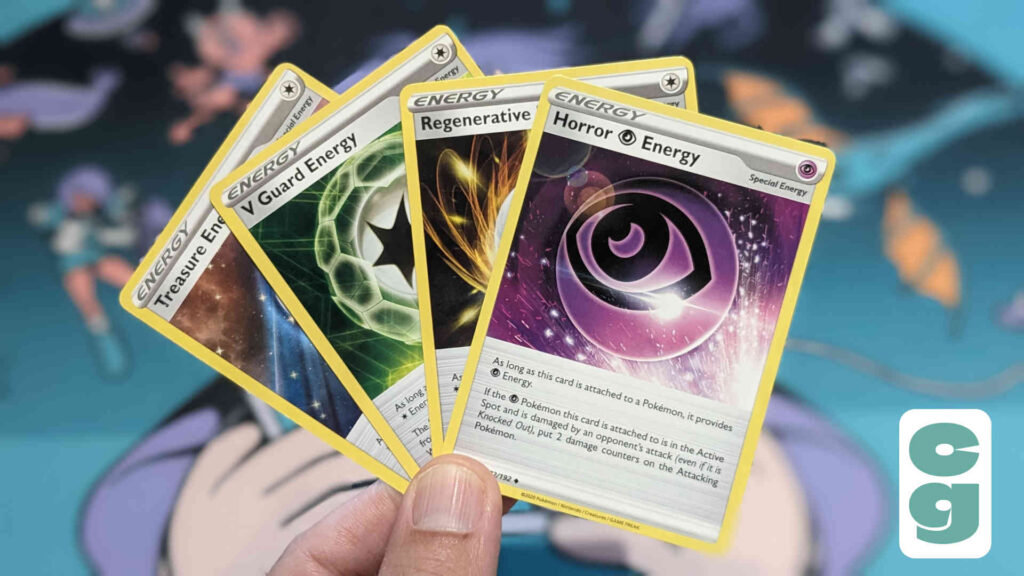
Note that Special Energy cards do exist in the Pokémon TCG too; these say ‘Special Energy’ on the top right of the card, and have abilities which are noted below the card’s illustration, as you can see above.
Trainer Cards
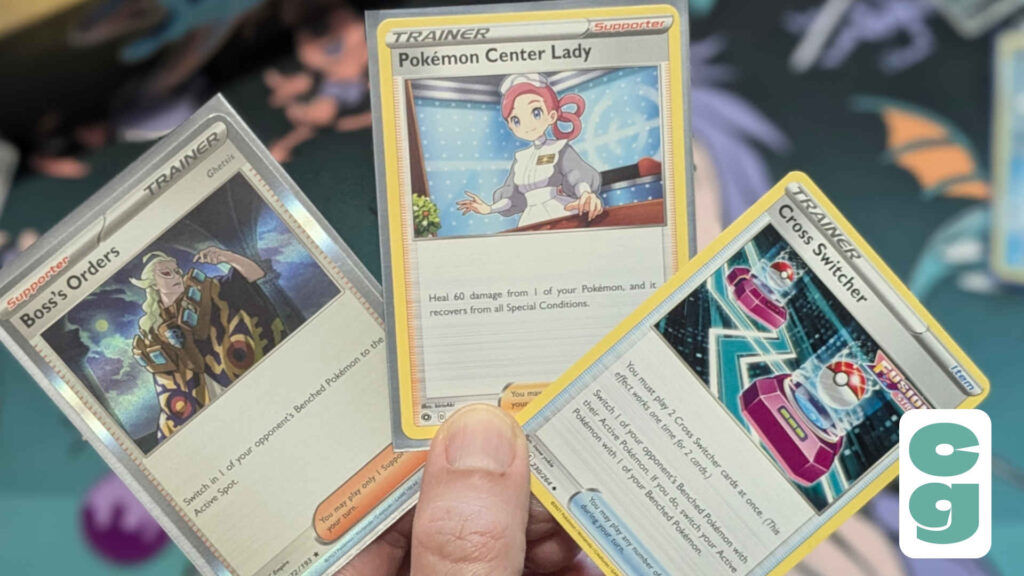
There are several types of Trainer card. You may play as many Items (such as the Cross Switcher in the above image) from your hand as you wish during your turn. Any number of Tools may be played from your hand per turn, but only one Tool may be attached to each Pokémon you have in play. Only one Stadium card may be in play at any time; if you play a new one, the current one is discarded.
You may only play one Supporter card per turn, as they tend to have much more powerful effects than other Trainer cards. Examples of Supporter cards can be seen above: Boss’s Orders and Pokémon Center Lady are in the photo, alongside Cross Switcher.
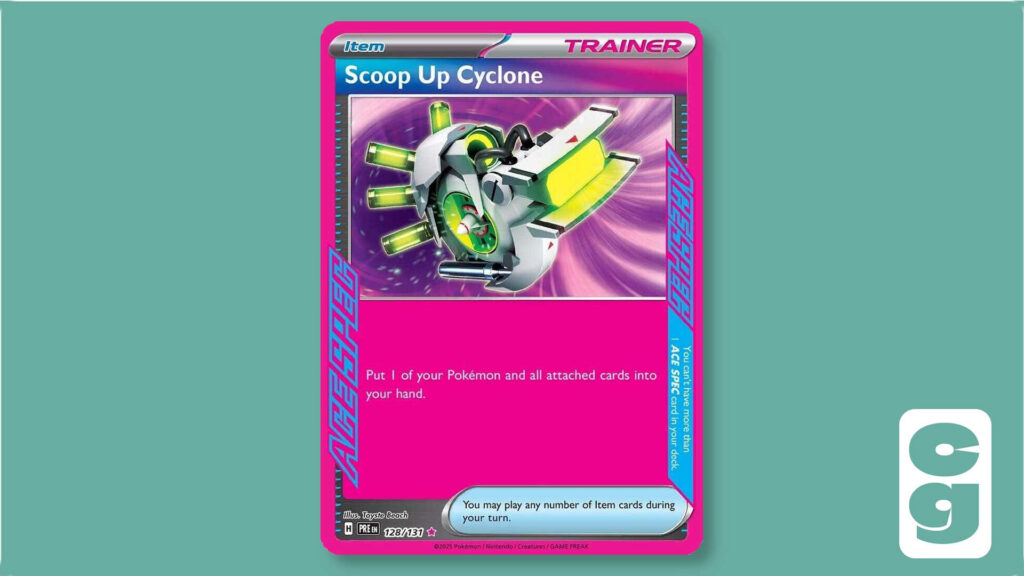
There are other subtypes of cards; we’ve covered the most common here. However, one card type that has been making a resurgence in recent sets are ACE SPEC cards. Scoop Up Cyclone, for example, is an Item card, but it’s also an ACE SPEC card. As they’re seen as more powerful than any other type of Trainer card, only 1 ACE SPEC card is permitted in a deck overall. You can see more of these in our ACE SPEC cards list.
Pokémon TCG Card Anatomy
Let’s take a look at a standard Pokémon card, and break down what each element of the card means. The card elements are numbered from 1-14 with yellow numerals, as you can see:
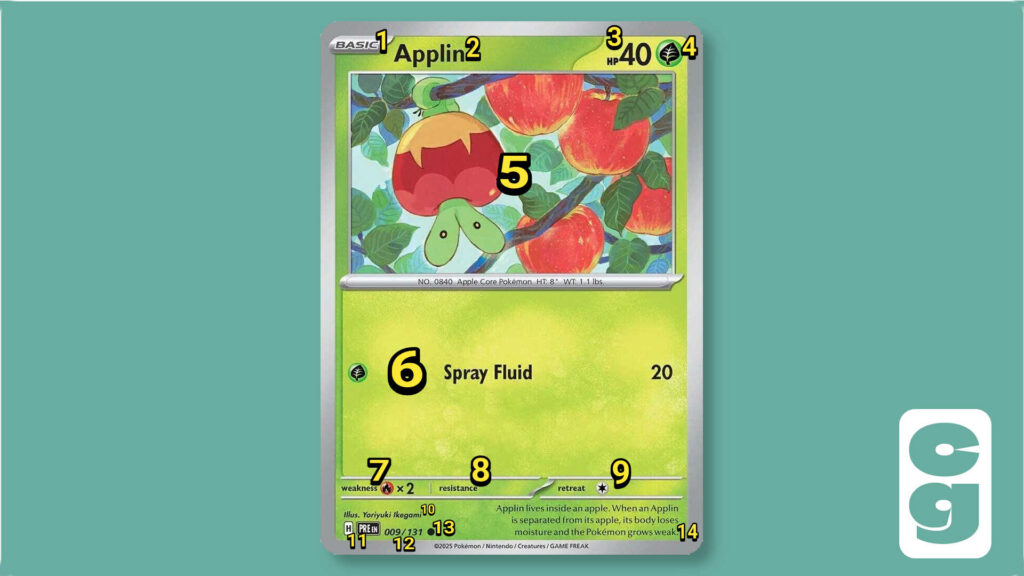
Here’s what each of numbered element means:
- Card Type: The word Basic here shows what type of Pokémon the card is; if it instead says Stage 1, that must be played on top of a Basic Pokémon to evolve it. The same is true of a Stage 2 Pokémon, which must be played on top of a Stage 1 Pokémon to evolve it. For a clearer and more in-depth explanation, check out our guide to evolving Pokémon.
- Card Name: This is the name of the Pokémon; in this example, it’s Applin.
- HP: This element is the Pokémon’s health; in Applin’s case, it begins with 40 HP.
- Energy Type: The Pokémon’s type is here; Applin is a Grass type Pokémon. You can read more about this in our guide to Pokémon Energy types.
- Illustration: The card’s artwork is here, and below the art are facts about the Pokémon, including its Pokédex number, its description (Applin is an ‘Apple Core Pokémon), along with its height and weight.
- Attacks: This area shows the Pokémon’s abilities and attacks. Applin has one attack, named Spray Fluid, which costs 1 Grass Energy to use and deals 20 HP of damage.
- Weakness: Most Pokémon types have a weakness to other Pokémon types; Applin, being a Grass Pokémon, has a weakness to Fire type Pokémon. That means that, if Applin is attacked by a Fire type Pokémon, double damage will be dealt to Applin. If Applin were to attack a Pokémon which has a weakness to Grass type Pokémon with Spray Fluid, it would deal 40 HP damage instead of 20.
- Resistance: Some Pokémon have a resistance to certain types; Applin doesn’t, as there’s no symbol in this section. However, when an Energy type symbol is shown here, it means that any damage dealt to the Pokémon is reduced by 30 HP.
- Retreat Cost: There’s numerous reasons why you’d want to move your Pokémon from the Active Spot to your Bench, and the retreat cost shows how many Energy cards, and which type, you need to discard from the Pokémon in order to do this. In the example of Applin, it costs 1 Colorless Energy (which means 1 Energy of any type) to move it from the Active Spot to the Bench.
- Artist Credit: The artist responsible for the card’s illustration is credited here.
- Tournament Legality and Set: the H In the white box shows the card’s current tournament legality (we’ve got a more in-depth guide on this here), and the PRE EN shows the set the card is from (PRE is for Prismatic Evolutions, and the EN is for the language the card is printed in, which of course is English).
- Set Number: There are 131 cards in the Prismatic Evolutions set, and Applin is card number 9. Which is why here, you’ll see the number 009/131.
- Card Rarity Symbol: The black circle shows the card rarity; in this case, that means Applin is a Common card. Further information can be found in our guide to Pokémon card rarity.
- Flavor Text: Though it has no bearing on the game, here you’ll find the Pokédex information for the Pokémon shown on the card.
Though some cards, such as cards with full or extended art, or even different types of card, will differ very slightly in their design, these categories can be applied to just about any card, in order to understand how they work in-game.
A Parent’s Guide to the Pokémon TCG
For a more comprehensive, self-contained look at playing, buying and even collecting the Pokémon TCG, take a look at our parent’s guide, which covers all the basics on every aspect of the game, including how to play!